Moringa Powder Benefits: Science-Backed Health Benefits (2026)
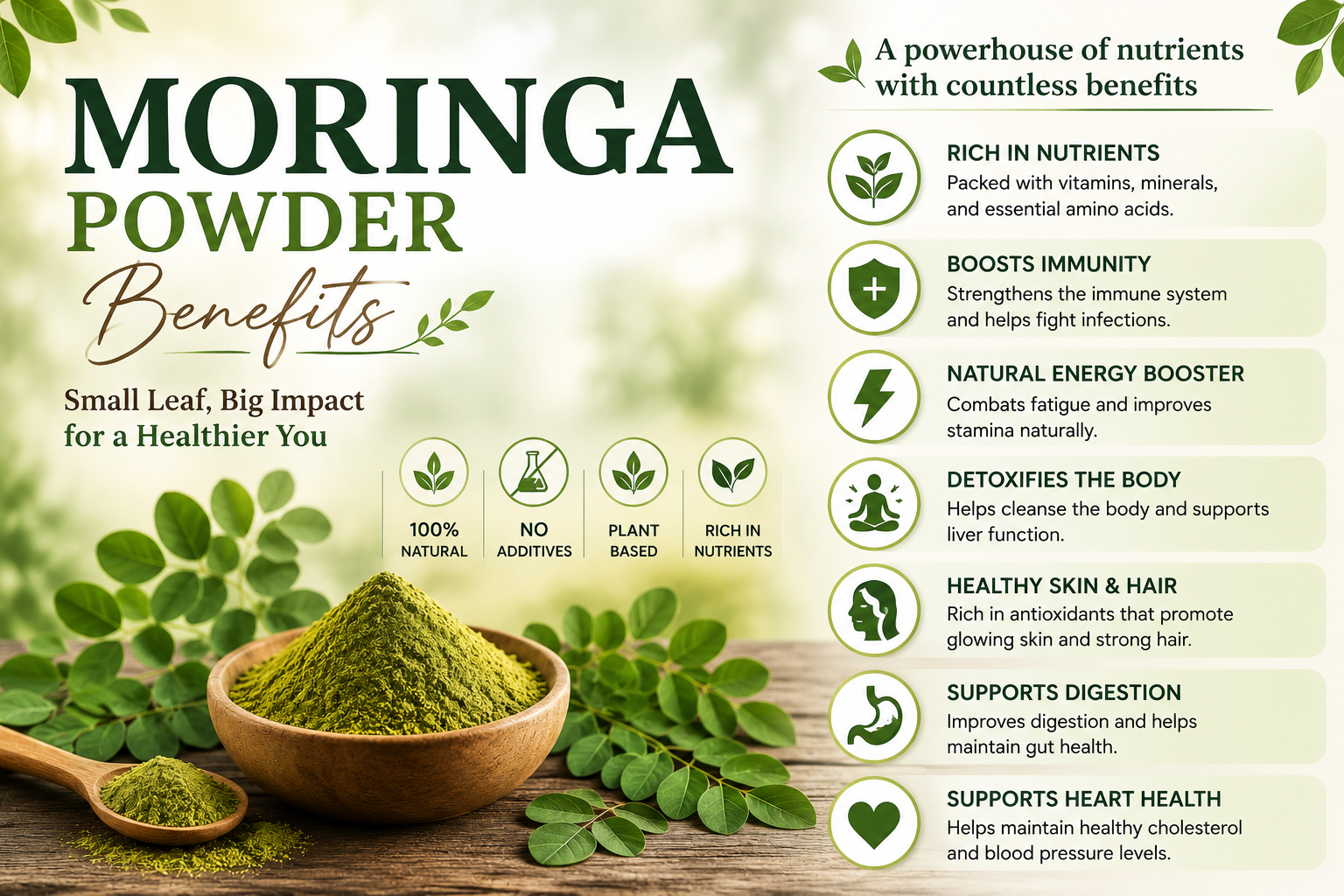
Moringa powder is a nutrient-dense whole food made from the dried leaves of Moringa oleifera. Current research suggests it may support overall nutrition, antioxidant defence, healthy blood sugar regulation, iron status, and inflammatory balance. However, while several benefits are supported by human studies, many popular claims still require stronger clinical evidence.
Moringa powder has become one of the most talked-about superfoods in recent years. From social media influencers to health blogs, it is often promoted as a natural solution for everything from low energy and weak immunity to diabetes, weight loss, and glowing skin.
But how much of this is actually supported by science?
The answer is more nuanced than many articles suggest.
Moringa (Moringa oleifera) is unquestionably one of the world's most nutrient-rich edible plants. Its leaves naturally contain dietary fibre, plant protein, iron, calcium, potassium, beta-carotene, vitamin E, and a diverse range of antioxidant phytochemicals. Because of this impressive nutritional profile, researchers have spent the last two decades investigating its potential role in supporting human health.
Some findings are genuinely encouraging.
Human clinical studies suggest moringa supplementation may help improve haemoglobin levels in nutritionally vulnerable populations, support healthy blood glucose management in certain adults with metabolic disorders, and contribute to breast milk production in some breastfeeding women. Laboratory studies have also demonstrated strong antioxidant and anti-inflammatory activity, although many of these findings still require confirmation through larger human trials.
At the same time, the internet is full of exaggerated claims.
Statements such as "moringa cures diabetes," "melts belly fat," "detoxifies the body," or "prevents cancer" are not supported by current high-quality clinical evidence. These claims often originate from laboratory experiments, animal research, or marketing material rather than well-designed human studies.
This distinction matters.
A laboratory study showing that a compound affects isolated cells does not automatically mean the same effect occurs in the human body. Likewise, promising animal research should be viewed as an early step in the scientific process rather than proof of clinical effectiveness.
That's why this guide takes a different approach.
Instead of repeating popular health claims, we'll examine what current scientific evidence actually shows, identify where research is strongest, explain where uncertainty still exists, and provide practical guidance on using moringa powder safely as part of a balanced diet.
Whether you're considering moringa to improve your nutritional intake, support general wellness, or simply understand why it has become so popular, this article will help you separate evidence from marketing and make informed decisions based on the best research available today.
What is moringa powder?
Moringa powder is made by drying and finely grinding the leaves of Moringa oleifera, a fast-growing tree native to the Indian subcontinent and now cultivated across Asia, Africa, and parts of Central and South America. The leaves have been consumed as food for centuries and are commonly used in traditional cuisines, particularly in India, where fresh moringa leaves are added to dals, curries, soups, and vegetable dishes.
To produce moringa powder, freshly harvested leaves are washed, gently dried, and milled into a fine green powder. Drying is an important step because excessive heat can reduce heat-sensitive nutrients such as vitamin C and affect the concentration of certain antioxidant compounds. Manufacturers that use carefully controlled drying methods generally preserve more of the leaf's natural nutritional value than those using high-temperature processing.
Unlike concentrated herbal extracts, moringa powder is a whole-food ingredient. This means it contains the leaf's naturally occurring combination of nutrients, dietary fibre, plant protein, vitamins, minerals, carotenoids, flavonoids, and polyphenols rather than isolated compounds.
From a nutritional perspective, moringa powder provides:
- Plant protein
- Dietary fibre
- Iron
- Calcium
- Potassium
- Magnesium
- Beta-carotene (provitamin A)
- Vitamin E
- Naturally occurring polyphenols and flavonoids
The exact nutritional composition varies depending on factors such as growing conditions, harvest maturity, drying technique, storage, and product quality.
Traditional Use vs Modern Research
Moringa has a long history of use in traditional systems of medicine, including Ayurveda, where it is known as Shigru. Traditionally, different parts of the plant have been used to support digestion, general vitality, and overall wellness.
Modern scientific research evaluates moringa differently. Instead of relying on traditional knowledge alone, researchers study its nutritional composition, biological activity, safety, and clinical effects through laboratory experiments, observational research, and human clinical trials.
This distinction is important.
Traditional use can provide valuable historical insight, but it does not automatically confirm clinical effectiveness. Likewise, promising laboratory findings do not always translate into meaningful health benefits in humans.
Current evidence supports moringa primarily as a nutrient-dense whole food. Research into its potential effects on blood sugar regulation, inflammation, antioxidant status, and other health outcomes is ongoing, with some findings showing promise while others require larger, better-designed human studies before firm conclusions can be drawn.
Throughout this guide, we'll clearly distinguish between well-established nutritional facts, emerging scientific evidence, and traditional uses so you can make informed decisions based on the strength of the available research.
Why is moringa considered a superfood?
The term "superfood" has no official scientific or regulatory definition. Instead, it is commonly used to describe foods that provide a high concentration of nutrients and beneficial plant compounds relative to their serving size.
Moringa is often described as a superfood because its leaves naturally contain a wide range of vitamins, minerals, dietary fibre, plant protein, and antioxidant phytochemicals in a minimally processed whole-food form.
Unlike many supplements that focus on a single nutrient, moringa provides a diverse nutritional profile that includes:
- Iron
- Calcium
- Potassium
- Magnesium
- Beta-carotene (provitamin A)
- Vitamin E
- Dietary fibre
- Plant protein
- Polyphenols
- Flavonoids
This broad nutritional composition has made moringa the subject of increasing scientific research in nutrition, food science, and public health.
Understanding why moringa is considered a superfood naturally leads to another common question: what is it actually good for in everyday life?
What Is Moringa Powder Good For?
Moringa powder is primarily valued for improving overall nutrition. It naturally provides dietary fibre, plant protein, iron, calcium, potassium, beta-carotene, vitamin E, and antioxidant phytochemicals. Current research also suggests it may support healthy blood sugar regulation, iron status, and inflammatory balance, although some proposed benefits require further clinical study.
Most people use moringa powder to:
- Increase daily nutrient intake
- Add more plant-based iron and calcium
- Support a balanced diet
- Enjoy a naturally caffeine-free green superfood
- Complement a healthy lifestyle
Although many health claims circulate online, current evidence supports moringa most strongly as a nutrient-rich whole food rather than a medicinal product.
Why Nutrient Density Matters
Nutrient density refers to the amount of beneficial nutrients a food provides relative to its calories.
Foods that are rich in vitamins, minerals, fibre, and beneficial phytochemicals while remaining relatively low in calories are generally considered nutrient-dense.
Moringa fits this description well.
For people whose diets contain few vegetables or who are looking to increase their intake of plant-based nutrients, moringa powder can be a convenient way to improve overall dietary quality.
However, nutrient density alone does not make a food a miracle ingredient.
Health outcomes depend on many factors, including overall diet, physical activity, sleep, genetics, medical conditions, and lifestyle habits.
Understanding Popular Nutrient Comparisons
You may have seen claims such as:
- "More calcium than milk."
- "More vitamin C than oranges."
- "More iron than spinach."
These comparisons are generally based on equal weights of dried moringa leaf powder versus fresh foods.
While technically true under specific conditions, they can be misleading because people typically consume much larger portions of fresh fruits and vegetables than moringa powder.
In addition, nutrient content varies depending on:
- Growing conditions
- Harvest maturity
- Drying method
- Storage
- Product quality
For this reason, it is more accurate to view moringa as a concentrated source of several important nutrients, rather than comparing it directly with individual foods.
Why Researchers Continue Studying Moringa
Scientists are interested in moringa for two main reasons.
First, its impressive nutritional profile makes it valuable from a public health perspective, particularly in populations where nutrient deficiencies remain common.
Second, moringa naturally contains bioactive plant compounds such as quercetin, chlorogenic acid, kaempferol, and other polyphenols that are being investigated for their antioxidant and anti-inflammatory properties.
Laboratory and animal studies have produced encouraging findings, while human clinical research continues to grow. Some health benefits are supported by moderate clinical evidence, whereas others remain preliminary and require further investigation.
For this reason, moringa is best described as a nutrient-dense functional food rather than a miracle cure.
Its greatest strength lies in supporting overall dietary quality as part of a balanced eating pattern, not in replacing medical treatment or healthy lifestyle habits.
Moringa Powder Nutritional Profile: What Makes It So Nutritious?
One of the biggest reasons moringa powder has attracted global attention is its impressive nutritional profile. Unlike many supplements that provide only one or two isolated nutrients, whole-leaf moringa powder naturally contains a diverse combination of vitamins, minerals, plant protein, dietary fibre, and antioxidant phytochemicals.
Its nutritional composition is one of the primary reasons researchers consider moringa a nutrient-dense functional food.
Approximate Nutritional Value Per 10 g (About 2 Teaspoons)
| Nutrient | Approximate Amount | Why It Matters |
|----------|-------------------:|----------------|
| Protein | 2.5–3 g | Supports muscle maintenance and normal body functions |
| Dietary Fibre | 2 g | Helps support digestive health and bowel regularity |
| Iron | 2–3 mg | Contributes to normal red blood cell formation and oxygen transport |
| Calcium | 180–200 mg | Supports healthy bones, teeth, and muscle function |
| Potassium | 250–300 mg | Helps maintain normal nerve and muscle function |
| Magnesium | 40–45 mg | Supports energy metabolism and muscle function |
| Beta-carotene | Varies | Converted by the body into vitamin A as needed |
| Vitamin E | Small amounts | Helps protect cells from oxidative stress |
> Note: Nutrient values are approximate and vary depending on growing conditions, harvest maturity, drying method, and product quality.
Beyond Vitamins and Minerals
Moringa powder also contains naturally occurring plant compounds that have become the focus of scientific research.
These include:
- Quercetin
- Kaempferol
- Chlorogenic acid
- Phenolic acids
- Glucosinolates
- Carotenoids
- Flavonoids
Many of these compounds have demonstrated antioxidant and anti-inflammatory activity in laboratory studies. Researchers continue to investigate how these compounds behave in the human body and whether they contribute to clinically meaningful health outcomes.
Nutrient Content vs Nutrient Absorption
A food may contain a nutrient, but that does not necessarily mean the body absorbs all of it.
This concept is known as bioavailability.
For example:
- The iron in moringa is non-heme iron, which is absorbed less efficiently than iron from meat or fish.
- Consuming moringa with vitamin C-rich foods such as lemon, oranges, tomatoes, or amla may improve iron absorption.
- Beta-carotene is a fat-soluble nutrient. Eating moringa alongside healthy fats such as yogurt, nuts, or seeds may improve its absorption.
Understanding bioavailability helps explain why nutrition experts focus on overall dietary patterns rather than individual foods.
Why Researchers Continue Studying Moringa
Scientists are interested in moringa not only because of its nutrient density but also because it combines nutrients with naturally occurring phytochemicals in a minimally processed whole-food form.
Current research suggests that this combination may contribute to several areas of health, including antioxidant defence, blood sugar regulation, inflammatory balance, and nutritional support.
However, nutrient-rich foods should not be confused with medicines.
Moringa's greatest strength is helping improve the nutritional quality of the diet. While some health benefits are supported by promising human research, others remain under investigation and require larger clinical trials before firm conclusions can be drawn.
This balanced interpretation reflects the current state of scientific evidence and provides a more accurate understanding of what moringa powder can realistically offer.
Evidence-Based Benefits of Moringa Powder
Moringa powder has been studied for a wide range of potential health benefits. However, the strength of evidence varies considerably.
Some benefits are supported by human clinical studies, while others are based mainly on laboratory or animal research. Understanding this distinction helps separate evidence-based information from exaggerated marketing claims.
The sections below summarize what current research shows.
---
1. Supports Overall Nutrition
Evidence Level: ⭐⭐⭐⭐⭐ Strong
Quick Answer
One of moringa powder's greatest strengths is its exceptional nutritional density. It naturally provides dietary fibre, plant protein, iron, calcium, potassium, magnesium, beta-carotene (provitamin A), vitamin E, and a wide range of antioxidant phytochemicals.
What Research Shows
Unlike many supplements that deliver only one or two isolated nutrients, moringa contributes a broad spectrum of vitamins, minerals, and plant compounds in a whole-food form.
Research consistently identifies moringa leaves as one of the most nutrient-dense edible plants currently studied. This makes moringa particularly valuable for people who consume few vegetables or wish to increase their intake of nutrient-rich plant foods.
Practical Takeaway
Think of moringa as a nutrient-rich food rather than a medicine. Its greatest benefit comes from improving overall dietary quality.
Does Moringa Powder Help Improve Daily Energy?
Moringa powder does not act like caffeine or energy drinks. Instead, it may help support normal energy production by contributing nutrients such as iron, magnesium, plant protein, and B-vitamin cofactors that play important roles in normal energy metabolism.
One reason many people search for moringa powder for energy is that they experience fatigue and are looking for a natural alternative to stimulants. Unlike coffee, energy drinks, or pre-workout supplements, moringa contains no caffeine.
Its reputation as an "energy food" comes primarily from its nutritional profile rather than from any stimulant effect.
Whole-leaf moringa naturally provides:
- Plant-based iron, which contributes to normal oxygen transport in the body.
- Magnesium, involved in hundreds of enzymatic reactions related to energy production.
- Plant protein, supporting normal body maintenance.
- Antioxidant compounds that help protect cells from oxidative stress.
People with poor dietary quality or low vegetable intake may notice improvements in overall vitality after improving their nutrition. However, this should not be interpreted as moringa directly increasing energy in the same way as caffeine.
Current research supports moringa primarily as a nutrient-rich whole food, not as an instant energy booster.
> Key Takeaway: If you're looking for sustainable daily nutrition instead of temporary stimulation, moringa powder can be a useful addition to a balanced diet. It supports nutritional status rather than providing a rapid "energy boost.”
---
2. Rich in Natural Antioxidants
Evidence Level: ⭐⭐⭐⭐☆ Moderate to Strong
Moringa contains numerous naturally occurring antioxidants that help protect cells against oxidative stress.
Why Researchers Study This
Oxidative stress occurs when free radicals accumulate faster than the body's natural antioxidant defences can neutralize them.
Moringa contains several antioxidant compounds including:
- Quercetin
- Kaempferol
- Chlorogenic acid
- Carotenoids
- Polyphenols
Laboratory studies consistently demonstrate antioxidant activity from these compounds.
What Human Studies Show
Some human studies have reported improvements in antioxidant biomarkers after moringa supplementation.
However, antioxidant activity measured in laboratory settings does not automatically translate into disease prevention in humans.
Practical Takeaway
Current evidence supports moringa as an antioxidant-rich food that contributes to a healthy dietary pattern.
Moringa Powder Benefits for Skin
Moringa powder contains antioxidants, beta-carotene, vitamin E, and polyphenols that help protect cells from oxidative stress. While these nutrients contribute to healthy skin, current research does not support claims that moringa treats skin diseases or dramatically improves appearance.
Healthy skin depends on many factors including nutrition, hydration, sleep, genetics, and sun protection.
Moringa contributes nutrients involved in normal skin maintenance, including:
- Beta-carotene
- Vitamin E
- Polyphenols
- Flavonoids
Researchers continue investigating whether these compounds influence skin health beyond their nutritional role.
At present, the strongest evidence supports moringa as a nutrient-rich food rather than a cosmetic treatment.
> Key Takeaway: Moringa supports healthy nutrition, which may contribute to healthy skin, but it should not be promoted as a treatment for skin conditions.
3. May Support Healthy Blood Sugar Regulation
Evidence Level: ⭐⭐⭐⭐☆ Moderate
Some human clinical studies suggest moringa may modestly improve fasting blood glucose and HbA1c in adults with metabolic disorders.
What Research Shows
Researchers believe compounds such as chlorogenic acid, isothiocyanates, and dietary fibre may influence glucose metabolism.
Recent systematic reviews report encouraging findings, particularly among adults with elevated blood sugar.
However,
study quality, participant characteristics, and dosages vary considerably.
Researchers consistently conclude that larger, high-quality clinical trials are still needed.
Practical Takeaway
Moringa may complement healthy eating and medical treatment, but it should never replace prescribed diabetes medication.
---
4. Supports Iron Intake and Healthy Haemoglobin
Evidence Level: ⭐⭐⭐⭐☆ Moderate
Moringa is naturally rich in non-heme iron and several nutrients involved in normal red blood cell formation.
What Research Shows
Several clinical studies have reported improvements in haemoglobin among nu
Shop the story
Handpicked from our collection.